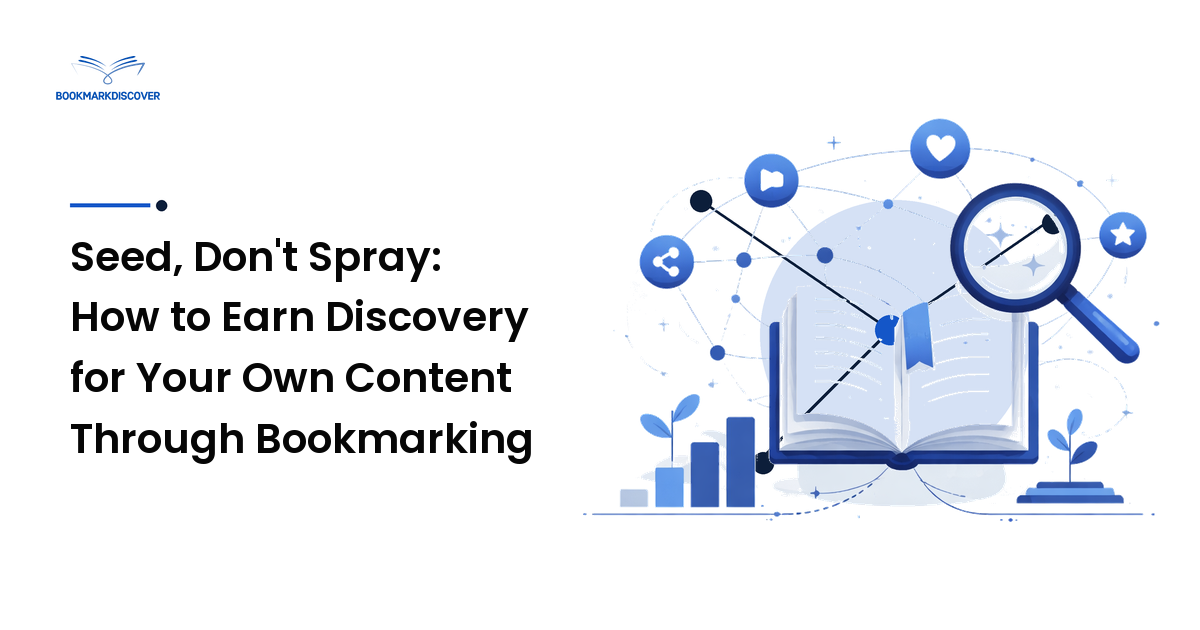
Everyone who publishes online eventually wonders the same thing: I made this good thing — how do people find it? A tempting answer is to blast the link across every bookmarking and sharing site you can, on the theory that more submissions means more visibility. It doesn't. Here's the takeaway up front: discovery is earned by seeding the right content in the right places, not by spraying links everywhere. The spray approach doesn't just fail to work — it actively gets your links flagged, ignored, and sometimes your accounts banned.
This guide explains why mass-submission backfires, lays out the seed-don't-spray method that actually earns discovery, works through a realistic example, and covers the mistakes that quietly waste your effort. It's vendor-neutral and honest: bookmarking is one real channel among many, never a traffic cheat code. For the mechanics of using bookmarking platforms well, pair this with the social bookmarking guide.
The hard problem: distribution is not the same as discovery
Posting a link somewhere is distribution. Getting a real person to click, read, and pass it on is discovery. The two are easy to confuse, which is why so much effort goes into the first while the second never happens.
Mass-submission optimizes distribution and ignores discovery. You can submit one URL to two hundred bookmarking sites in an afternoon and feel productive — but if those sites have no relevant audience, no human ever sees it. Worse, identical titles and blurbs repeated across sites are the textbook signature of spam, so platforms suppress them and search engines discount them. You end up with two hundred submissions and zero discovery, plus a footprint that makes you look like a spammer.
Discovery only happens where attention already lives: communities with real members interested in your topic. That's a small number of places, not a giant list.
The method: seed, don't spray
Seeding means placing your content deliberately where it has a genuine chance to be seen, with a presentation tailored to that place. Four principles:
- Earn the right to share first. Communities surface links from members who already participate. A bookmarking or niche community where you've only ever dropped your own links treats you as spam. Read, save others' good content, and contribute before you ask for attention.
- Choose relevance over reach. Five submissions to communities that actually care about your topic beat five hundred to generic link dumps. Relevant placement gets clicks; irrelevant placement gets buried.
- Tailor every submission. A title and description written for that audience — not copy-pasted — is what survives moderation and earns a click. Unique framing per place is the single biggest difference between seeding and spamming.
- Lead with genuinely shareable content. No distribution method rescues a thin page. Discovery compounds when the thing being discovered is worth passing on; it dies instantly when it isn't.
Seeding is slower than spraying. That's the point — the friction is what keeps it credible, and credibility is what earns discovery.
A worked example
Say you've written a strong, specific guide and want it found.
The spray approach: you paste the same title and one-line blurb into 150 bookmarking sites in an evening. Most submissions land on low-traffic or dead platforms; the duplicate copy gets several flagged; total real visits over the next month: a handful, possibly zero, and your link now appears in a pattern that looks manufactured.
The seed approach: you identify the five or six bookmarking and topic communities where people who'd actually want this guide gather. You've already been a real member of two. For each, you write a title and a two-sentence description suited to that audience — what they'll get, in their language. You submit, then engage honestly with any responses. Over the next month a few of those placements send real, interested readers; one community member reshares it, and that reshare — a genuine human signal — drives more than all 150 spray submissions combined.
Same page, a fraction of the submissions, vastly more discovery. The difference isn't volume; it's relevance and authenticity.
Common mistakes and why they happen
- Counting submissions instead of clicks. Submission count feels like progress because it's easy to rack up. But the only number that matters is real referral visits and reshares. Measure outcomes, not activity.
- Reusing one title and blurb everywhere. It's faster, which is exactly why it's a spam signal. Platforms and search engines both treat duplicated submissions as low-value. Tailor each one.
- Showing up only to take. Dropping links in communities you've never contributed to gets you flagged and often banned. Discovery channels are reciprocal; participate first.
- Treating bookmarking as a ranking hack. Expecting submissions to "rank" a page directly leads to disappointment and risky behavior. Bookmarking helps content get seen and shared; the lasting visibility comes from people who then link to or return to it.
- Spraying weak content harder. When a page doesn't get traction, the instinct is more submissions. If the content isn't shareable, more distribution just spreads the disappointment wider.
People fall into these because spraying is fast, measurable, and feels active — while seeding is slow, patient, and only pays off downstream.
Edge cases and caveats
- Bookmarking is one channel, not the channel. Treat it as part of a mix (email, your own audience, relevant communities), never the whole plan.
- Some niches have few real communities. If only two relevant places exist, use those two well rather than padding with irrelevant ones. Quality of placement beats quantity every time.
- Reshares matter more than your own posts. Your submission is a seed; a member resharing it is the plant. Optimize for content people want to pass on, because that signal outperforms anything you submit yourself.
- No method beats a thin page. If discovery keeps failing, the honest fix is usually the content, not the distribution.
The one move to remember
Before submitting anywhere, ask: would a real member of this community genuinely want this link? If yes, tailor the submission and seed it. If no, don't submit — you'll only train the platform to treat you as noise. That one filter turns scattershot link-dropping into discovery you actually earn.
FAQ
Does submitting my links to bookmarking sites improve visibility?
It can, but only on relevant platforms with real audiences and with tailored, genuine submissions. Mass-submitting identical links to generic sites gets flagged and earns almost nothing. The visibility comes from real people seeing and resharing, not from the raw number of submissions.
Will bookmarking my pages help them rank in search?
Not directly or reliably. Bookmarking helps content get discovered and shared by people, and that human attention can lead to lasting links and return visits. Treat it as a discovery channel, not a ranking lever, and you'll set realistic expectations.
How many places should I submit a piece of content to?
Far fewer than you'd think — a handful of genuinely relevant communities, each with a tailored submission, beats hundreds of generic ones. Relevance and authenticity drive discovery; volume mostly drives spam flags.
How do I avoid getting my accounts flagged or banned?
Participate before you promote, never reuse the same title and blurb across sites, and only submit where your content genuinely fits. Spam filters react to repetition and self-only behavior, so being a real, varied community member is your best protection.
What should I measure to know it's working?
Real referral clicks, time on page from those visitors, and reshares — not submission counts. If a placement sends interested readers or earns a reshare, repeat it; if it sends nothing, drop it and reinvest the effort in better-fitting communities.
Next step
Pick your three strongest pages and, for each, find a handful of communities whose members would genuinely want it. Write a tailored title and blurb for every one, seed them, and track real referral clicks and reshares over the next month. Keep what earns attention, drop what doesn't — and let volume go. Seeding beats spraying every time.